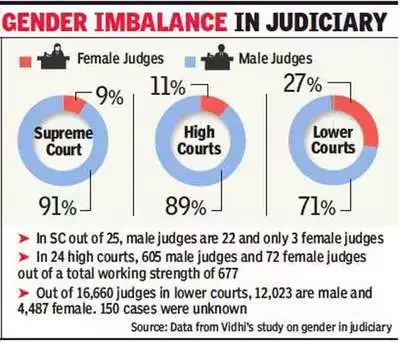
- The Supreme Court has rarely had more than one or two sitting women judges at a time. Only 14.85% of judges across India’s 25 High Courts (116 out of 781 sitting judges) are women, with deep structural barriers restricting promotion.
- In over 70 years, fewer than 10 Scheduled Caste judges have ever been appointed to the Supreme Court of India. Justice H.K. Sema, a retired Supreme Court judge (2002–2008) from Nagaland, is notably recognized as the only judge from a Scheduled Tribe (ST) community in the history of the Supreme Court of India.
- 30 of the 33 judges currently in the Supreme Court are Hindu, with one Muslim, Christian and Parsi each. There has been no Sikh representation in the Supreme Court since Justice J.S. Kehar, who retired as Chief Justice in August 2017.
These three points are the main gist of the whole article. Upper-caste men have dominated the judiciary since the inception of the justice system, and there are no signs of improvement.
1. The Gender Gap and Structural Barriers
Historically, less than 3.3% of Supreme Court judges have been women, and as of 2023-2025, the court often operates with only a single female judge. No woman has ever served as the Chief Justice of India. Only 14% of current High Court judges are women as of August 2024.
- The Seniority Norm: An unwritten rule favoring the elevation of the most senior High Court judges to the Supreme Court. Because women often enter the profession later or take career breaks for familial reasons, they are less likely to achieve the necessary seniority.
- The Transfer Policy: Subordinate judges are often prohibited from serving in their place of residence or their spouse’s residence. This disproportionately affects women, who are socially expected to manage household and childcare responsibilities.
- Mandatory Practice Requirements: The recent reinstatement of a three-year mandatory practice rule for junior judicial aspirants is described as a case of indirect discrimination. By delaying eligibility to ages 26–27, the rule hits women at a life stage where societal and familial pressures to marry and prioritize domestic duties are highest.
As of March 2026, there is only one sitting woman judge in the Supreme Court of India: Justice B.V. Nagarathna.
In the 75-year history of the Supreme Court, only 11 women have been appointed as judges, making up only 4% of the total 276 judges. Justice B.V. Nagarathna is set to become the first female Chief Justice of India in September 2027. -
Infrastructure and Environment: Many courts lack basic facilities like female washrooms or childcare spaces, and women frequently encounter sexist language and a "hostile" work environment dominated by male peers.
- Judicial Language on Caste: A 2025 Supreme Court report on judicial conceptions of caste revealed contradictory discourse. While some judgments challenge caste narratives, others downplay the pernicious nature of the system or use problematic metaphors—such as equating affirmative action to "crutches" or a "handicap"—which the sources argue violates the dignity of marginalized groups. While the report acknowledges that changing legal terminology cannot singlehandedly dismantle systemic inequality, it argues that language shaped by constitutional values is essential for a more just society. Ultimately, this work serves as a call for judicial self-reflection, urging the state to adopt vocabulary that accurately reflects the social realities and struggles of Dalit communities.
- Intersectionality: True inclusivity requires representation across gender, caste, religion, and regional backgrounds to allow for intersectional voices. The failure to consider the needs of those from marginalized socioeconomic backgrounds is identified as a violation of the constitutional mandate of equality.
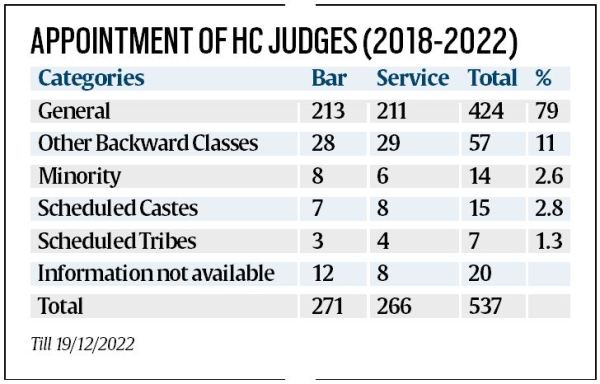
- Brahmins dominate the bench, holding approximately 36% of seats in the Supreme Court as of 2025, with 12 out of 33 judges from Brahmin backgrounds. Even in High Courts, where forward castes account for 79% of appointments over the last five years, while the representation of Scheduled Castes (SC) and Scheduled Tribes (ST) hovers at a mere 10%, a decline from previous decades.
- Chief Justice of India: The President appoints the CJI, with the outgoing CJI traditionally recommending their successor based strictly on seniority.
- Supreme Court Judges: Proposals are initiated by the CJI, who consults the Collegium and records their opinions in writing. The recommendation is sent to the Law Minister, then the Prime Minister, who advises the President.
- High Court Judges: These appointments are recommended by a Collegium comprising the CJI and two senior-most SC judges, though the process is initiated by the outgoing Chief Justice of the relevant High Court.
- Lack of Transparency: Critics describe it as a "closed-door mechanism" with no official secretariat or public minutes of proceedings.
- Accountability and Favouritism: Because there are no specific criteria for selection, critics argue the system is prone to nepotism and favouritism, where judges may recommend those they know rather than the fittest candidate.
- Checks and Balances: The complete exclusion of the Executive is seen by some as a violation of the principle of checks and balances among the three organs of government.
- Representation: There are concerns regarding the underrepresentation of women and marginalized groups in the higher judiciary.
In summary, while empirical data suggest that Indian judges largely uphold their roles without pervasive gender or religious bias in outcomes, structural and discretionary biases in the appointment and promotion process continue to entrench a male-dominated hierarchy that lacks the diversity of the population it serves. To realize the constitutional vision of social justice, India’s judiciary must eliminate both conscious and unconscious caste bias and ensure adequate representation of marginalized communities. Whether through the Collegium System or the National Judicial Appointment Commission, appointing judges from the Scheduled Castes and the Scheduled Tribes is essential. Greater inclusivity in the Supreme Court is not only a matter of representation but also crucial to ensuring fair and balanced judgments, as the absence of such voices has already impacted judicial outcomes in significant cases. There are massive vacancies in our courts; appointing diverse judges will create a great impact on our law and order situation.